
How to Choose the Perfect Dining Table for Your Home
This post may contain affiliate links. If you make a purchase through one of my links, I may make a small profit at no expense to you. For further information, please view my policies.
Choosing a dining table is one of the biggest furniture decisions you’ll make for your home.
And while it’s easy to fall in love with a table based on looks alone, the best choice also depends on your room size, lifestyle, and how you use your dining space every day.
In this guide, I’ll walk you through everything you should consider before buying a dining table, from choosing the right size and shape to selecting a material that suits your home.

When purchasing a dining table, I think about it the same way I do when shopping for a sofa. I want it to feel current without chasing trends, and I choose a finish that I know will work with a variety of color palettes for years to come.
If you buy anything too trendy, you might regret it down the line, so be mindful about the decisions you make now!
Things to Consider Before Buying a Dining Table:
- Pay attention to size: you want to be able to leave about 3 feet of breathing space on each side of your dining table. Trust me: this makes a HUGE difference in the flow of your space!
- Keep in mind how many people you normally need to seat at your dining table.
- Think about your room style and how your dining table will fit into your existing decor.
- Think about furniture placement: where will the table go and how will it affect what you already have in place?
- Do you need an extendable dining table? Or perhaps a table with a drop leaf would work.
- Do you have kids? Look for something sturdy that won’t slide around easily, and consider whether the tabletop is a material that scratches, and is easy to wipe down.
- Always measure your space before buying, especially if you’re purchasing online.

How to measure for the perfect dining table
The best way to ensure you don’t end up with a dining table that doesn’t fit your space properly is to measure the whole area that is intended to be your dining space.
Whether your space is square or rectangular will also affect what kind of table you should be purchasing (more on that below).
Regardless of the shape or size you end with, you should try to have about 3 feet on each side of your table for optimal flow in your arrangement.
- First, measure the length and the width of your intended dining space.
- Next, you’ll want to subtract around 6 feet from the length of your room, and subtract 6 feet from the width of your room. That should give you the approximate size of the table you need for your space.
- If you’re going for a circular or oval table, round up or down to the nearest measurement.

Visual weight
It’s not just physical size that matters – it’s important to make sure you’re picking a table that has a visual weight that works with the dimensions of your space.
Just because a table fits dimensionally, it doesn’t mean it’s the right choice for your space. Picking a table that is too dark or too bulky, will make it look much bigger than it actually is. So if your table has either of those characteristics, make sure you have enough space to support that style decision.
Choosing the right material
One of the biggest decisions you’ll make isn’t the shape of your dining table. It’s the material.
Solid wood tables are timeless, can often be refinished, and develop character over time, making them an excellent long-term investment.
Veneer tables can be a great budget-friendly option and often look almost identical to solid wood, but they’re generally more difficult to repair if damaged.
Glass tables help a room feel lighter and more open, making them a smart choice for smaller dining areas, although they do require more frequent cleaning.
Stone and marble tables create a beautiful statement but are often much heavier and require more care to prevent staining or etching.
Round Dining tables

When and why should you use a round dining table?
If you have a small dining area, or your room is square-shaped but a square table feels too bulky for your space, then you could consider using a round dining table.
Some situations where round dining tables can look great are in small dining nooks (like this one!), in tight corners with benches on one side, or in bay windows.
I wouldn’t recommend using a round table in a rectangular room.
Round tables are typically great for facilitating conversation because all the guests can sit around them equally and nobody gets left out of the conversation. This happens a lot when two people are seated on opposite sides of a long, rectangular dining table and they have to shout at each other in order to talk!
I would recommend round tables to seat smaller gatherings. Really large round tables aren’t practical and honestly don’t look very good. If you want a round table but need to seat large gatherings from time to time, then consider getting a table with an extension leaf.
One thing to keep in mind is that very large round tables with a single pedestal base can sometimes be less stable than tables with four legs. If you have young children or expect heavy daily use, it’s worth considering the base design as well as the tabletop.
Rectangular Dining Tables

Rectangle dining tables are probably the most popular shape when it comes to dining tables. For that reason, it’s easy to find a large variety of styles of rectangle shaped dining tables when you’re shopping.
When and why should you use a rectangular dining table?
A rectangular dining table is versatile for different kinds of seating patterns, since both benches and chairs may be utilized to seat people.
If you have a large family or you host dinner parties often, then rectangular is the way to go. They allow for larger gatherings of people and are generally more practical for that sort of thing.
Use a rectangular dining tables if you’ve got a long dining space, and avoid using a rectangle table in a square room.
The biggest downside is usually cost. Larger rectangular tables simply require more material, so they tend to be more expensive than smaller or round alternatives.
Square dining tables
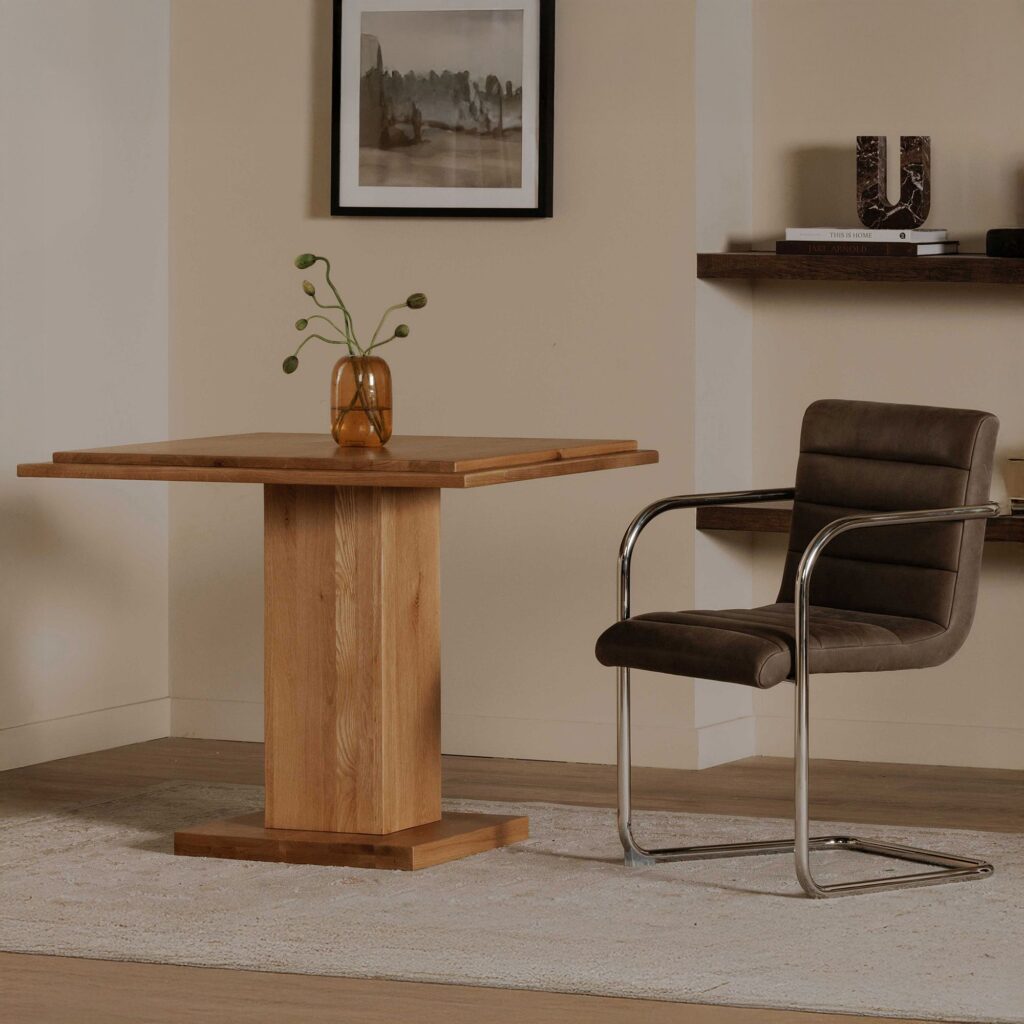
When and why should you use a square dining table?
Do you have a square dining room? Then you’ll probably want to use a square dining table (or round would work too). Symmetrical rooms will remain balanced and proportioned with the use of a square table.
A good reason to pick a square dining table could be if you usually dine with 4 people. Each person gets their own side, and each person is therefore equidistant from the other.
Oval dining tables
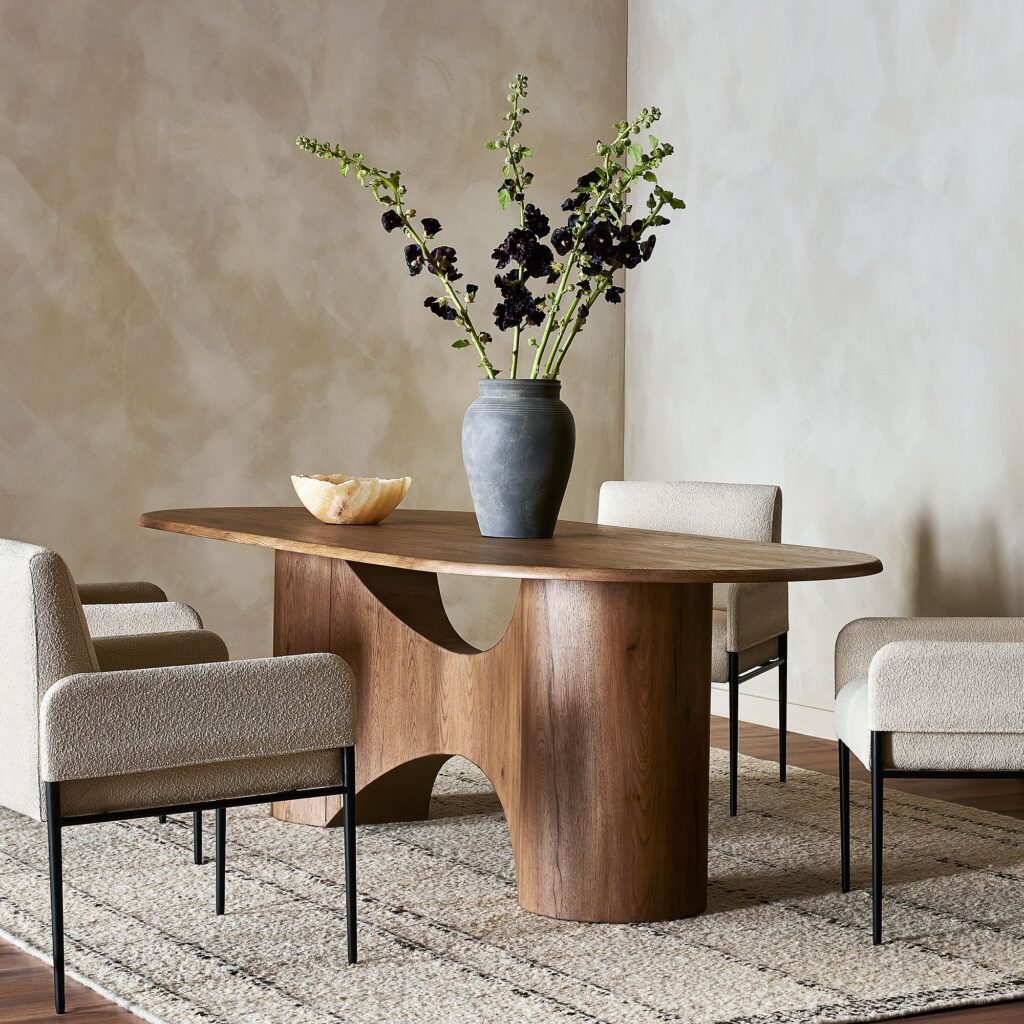
If you’ve got a really long and narrow space, consider using an oval table instead of a rectangle.
Cutting off those corners will give you a little less surface to eat and work on, but will give you a few more inches of breathing room. The rounded corners and spherical shapes can really help ease up the flow in a tight room.
Choosing the right dining table comes down to balancing size, shape, material, and the way you actually live. While trends come and go, a well-proportioned table in a timeless finish can easily last for many years.
Take the time to measure your space, think about how you use your dining room, and choose a table that suits your lifestyle just as much as your decorating style. It’s an investment you’ll likely live with every day, so it’s worth getting right.


Thank you for these tips- they were so helpful! (Your links. for the tables aren’t working.)
Thanks for this post! I’m in the market for a new dining table. I think there’s a typo in the rectangular table section, it says “When and why should you use a *round* dining table?”
Thanks for spotting that! Pesky typos 🙂